Featured
Holy B3 – Hollywood é qui: An AI-Powered Journey Through History and Truth – A Critique Review


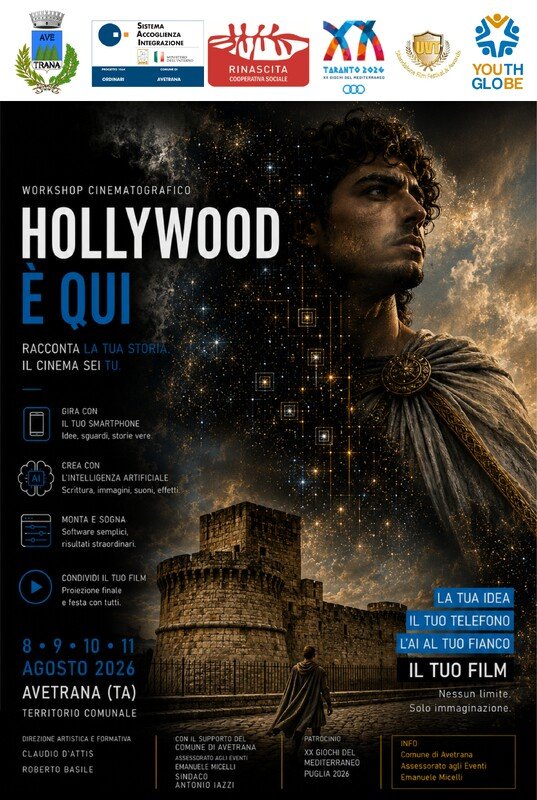
Holy B3 – Hollywood é qui is the latest chapter on Claudio d’Attis’s Holy B3 series, and much like his other films, it remains a fascinating experience that you will want to watch twice – though, this time, the film is more of a group effort. Co-written by Roberto Basile and produced by the Municipality of Avetrana and the patronage of the Mediterranean Games Taranto 2026 and the prompts written by the photographers who took part of d’Attis’s workshop, this is solid evidence of how, despite the use AI, filmmaking will always find ways to bring together an entire community.
As noted, we have covered d’Attis’s works a couple of times before and they’re always something unique to watch for many reasons. First of all, their use of AI comes as an interesting view on what the future of filmmaking might look like, especially among indie filmmakers. But it’s not just about how his films are made, but what they talk about and what they are trying to say.
“Our initiative had several objectives. First, to rediscover and celebrate the history of Avetrana. Second, to highlight the role of AI in each of our lives and its implications for future career opportunities. Third, to explore how culture, cinema, and artificial intelligence can create opportunities for people to consider returning to their homeland to live and work. The workshop now gives Avetrana the opportunity to tell its story and showcase its heritage, its history, and the culture of its people”. – Prof. Antonio Iazzi, producer of “HOLLYWOOD È QUI”.
Throughout this series, we have seen a fascinating take on the connection between AI and religion or church, and the result has always been thought-provoking to say the least. His films are far from conventional, and this new one is no exception.
The first thing to say about Hollywood é qui, though, is that it takes a rather drastic turn to its themes. Less focused on the connection between AI and religion, d’Attis has decided to explore more of Italian history, culture, and, possibly, folklore, and to do so on a considerably shorter length to his usual works.


Make no mistake: the effort remains intriguing, though it does feel considerably less complex than his previous work. In a way, this feels like an improvement as he has made his ideas easier to follow and what we see here is the reinterpretation of an ancient tale – that of a young boy called Cria, who was once considered a traitor for leaving the army during the Turkish expedition at Torre Colimena. However, as the film develops, we learn that Cria’s story might have been told the wrong way, and that there is more to certain stories than meet the eyes, thus inviting us to reconsider what we think we know.

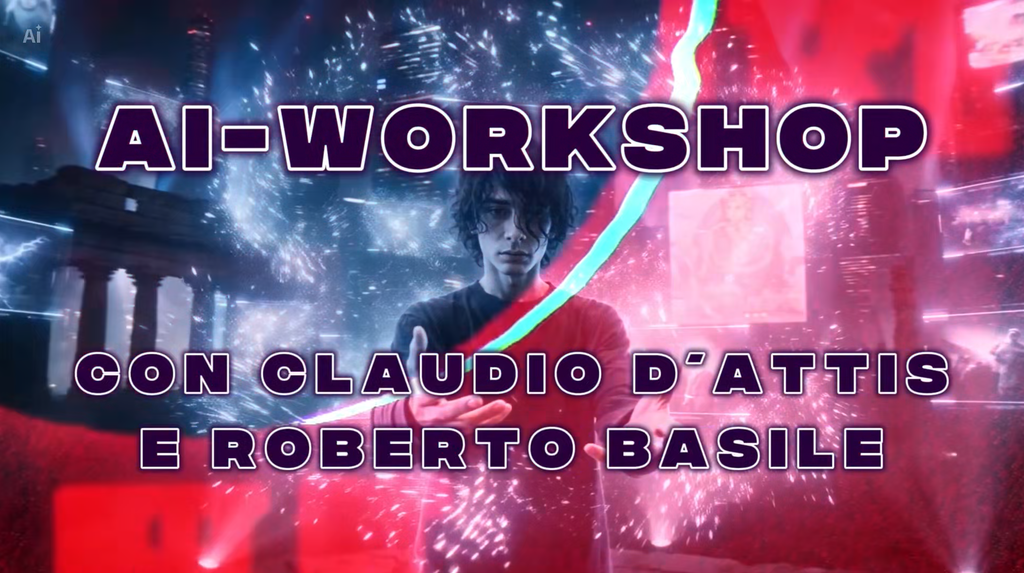
The film, then, results in a beautiful take on subjects such as empathy and trying to understand each other, all while learning about Italian history. The fact that we get to experience all of this in less than five minutes makes the effort even more impressive.
However, the film can feel a little confusing in its execution and some decisions that came across as a little odd. Made almost entirely with AI, the film suffers from some flaws that AI is still learning to overcome. As still photos, the images do their job fine. Elements such as the little girl watching the fresco, Cria’s hologram, his flashback, the students, and the party work very well, but once some of these begin to move, some moments and actions can look somewhat clunky, particularly during one sequence involving no other than Spider-Man. On that note, this decision felt a bit risky and distracting. Granted, we can guess that the film was trying to connect its protagonist with one of the most beloved American heroes, but, still, it can be a little distracting, especially, again, for the way this character moves during some action-driven sequences.


Similarly, the visual style of some of these images might feel a little disconnected from each other, which might make it somewhat harder for the audience to fully understand without reading the film’s overview.
So, it’s a solid and ambitious effort and an interesting new entry to the Holy B3 series, and we quite recommend you all to watch it, but it might require either a second watch or access to the film’s premise, and overview to fully embrace it.
That said, the film offers an excellent line that will likely stay with its audience: “The truth does not belong to those tells it, but those who keep searching it.”